

Whole Bean vs Ground Coffee: Which Is Better?
When buying coffee, one of the first decisions you'll make is simple:
Should you buy whole bean coffee or ground coffee?
Both can make an excellent cup of coffee. The biggest difference is when the coffee is ground.
Whole bean coffee stays intact until you're ready to brew, while ground coffee is already prepared for your coffee maker.
That difference affects freshness, aroma, convenience, grind control, storage, and brewing flexibility.
The Specialty Coffee Association explains that grinding dramatically increases the surface area of coffee and accelerates the loss of carbon dioxide and volatile compounds.
So which one should you choose?
Let's compare them.
Whole Bean Coffee vs Ground Coffee at a Glance
| Feature | Whole Bean | Ground Coffee |
|---|---|---|
| Freshness | ⭐⭐⭐⭐⭐ | ⭐⭐⭐ |
| Aroma | Excellent | Good |
| Convenience | Requires grinding | Ready to brew |
| Grind control | Complete | Limited |
| Equipment needed | Grinder required | No grinder needed |
| Brewing flexibility | Excellent | Depends on grind |
| Storage | Easier to preserve | More sensitive to air |
| Best for | Coffee enthusiasts | Convenience-focused drinkers |
| Beginner-friendly | Moderate | Excellent |
Neither option is automatically "better" for everyone.
The best choice depends on how you brew and what you value most.
What Is Whole Bean Coffee?
Whole bean coffee is coffee that has been roasted but has not yet been ground.
You grind the beans immediately before brewing.
This gives you control over the size of your coffee grounds.
For example:
French press → coarse
Drip coffee → medium
Pour over → medium to medium-fine
Espresso → fine
Cold brew → coarse
That flexibility is one of the biggest advantages of whole bean coffee.
What Is Ground Coffee?
Ground coffee has already been crushed into smaller particles before you purchase it.
That means you can open the package and start brewing immediately.
It's convenient for:
-
Drip coffee makers
-
Office coffee
-
Busy mornings
-
Large households
-
People without grinders
-
Quick daily brewing
The tradeoff is that you have less control over grind size and the coffee has more surface area exposed to the environment.
Why Whole Bean Coffee Can Stay Fresher
This is one of the biggest differences between whole bean and ground coffee.
When coffee is ground, its surface area increases dramatically.
That gives oxygen and the surrounding environment more opportunity to interact with the coffee.
The SCA explains that grinding accelerates carbon dioxide loss and other freshness changes. Its educational material notes that whole-bean coffee can retain freshness on a longer timescale than ground coffee, although the exact period varies with packaging, storage, roast, and other conditions.
That's why many coffee enthusiasts follow a simple rule:
Grind your beans as close to brewing as practical.
Why Freshly Ground Coffee Smells So Good
Have you ever ground coffee and immediately noticed a huge burst of aroma?
That's because grinding releases volatile compounds that were previously contained within the roasted coffee structure.
You are essentially opening up the coffee.
That aroma is part of what makes freshly ground coffee so enjoyable.
The downside is that once those compounds are exposed, freshness changes happen more rapidly.
So:
Grind → Brew → Enjoy
is generally preferable to:
Grind → Leave exposed → Brew much later
The Biggest Advantage of Ground Coffee: Convenience
Let's be honest.
Not everyone wants another step in their morning routine.
If you're rushing to work, ground coffee can be extremely convenient.
You simply:
-
Open the package.
-
Measure your coffee.
-
Add water.
-
Brew.
-
Enjoy.
No grinder.
No grinding adjustments.
No extra cleanup.
For many people, that convenience outweighs the advantages of whole beans.
And that's completely fine.
Whole Bean Gives You More Control
With whole beans, you control the grind.
This is particularly useful if you use different brewing methods.
Imagine you own:
-
A French press
-
A pour-over brewer
-
An espresso machine
-
A cold brew setup
You can use the same whole beans and adjust the grind for each method.
With pre-ground coffee, you're limited to the grind that was selected before purchase.
Grind Size Matters
Coffee grind size affects how water interacts with the grounds.
Coarse
Best suited for:
-
French press
-
Cold brew
-
Some immersion brewing
Medium
Common for:
-
Drip coffee
-
Automatic coffee makers
Medium-Fine
Often useful for:
-
Pour over
-
Some AeroPress recipes
Fine
Used for:
-
Espresso
Using the wrong grind can affect extraction and flavor.
That's another reason whole bean coffee can be attractive to people who enjoy experimenting with brewing.
Whole Bean vs Ground Coffee for French Press
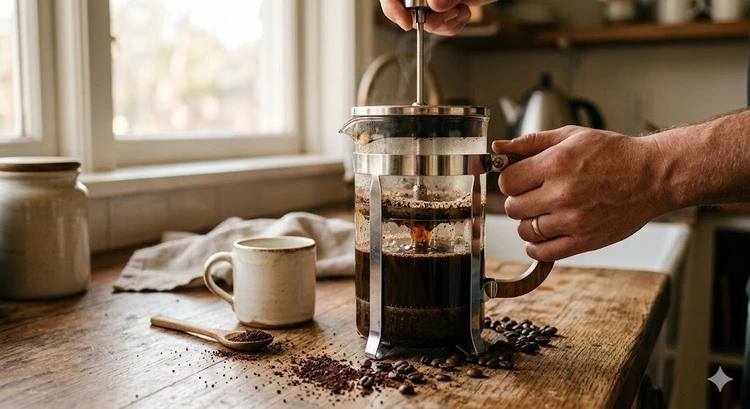
If you use a French press, whole beans give you the ability to grind specifically for the method.
Start with a coarse grind.
This can help produce the type of extraction and texture commonly associated with French press brewing.
If you're purchasing pre-ground coffee, look for coffee specifically ground for French press or coarse brewing.
Whole Bean vs Ground Coffee for Espresso
Espresso requires a much finer grind than most drip brewing methods.
Whole beans are especially useful here because espresso brewing can require small grind adjustments.
A grinder allows you to make those adjustments.
If the espresso tastes too sour, bitter, weak, or extracts too quickly or slowly, changing the grind can be one of the variables you experiment with.
Whole Bean vs Ground Coffee for Cold Brew
Cold brew generally works well with a coarse grind.
Whole beans let you grind specifically for your cold brew recipe.
If you're buying ground coffee, choose one intended for coarse brewing or cold brew when available.
Which Has Better Flavor?
This is where the answer becomes subjective.
Whole bean coffee can offer:
-
Stronger aroma
-
Greater grind control
-
More brewing flexibility
-
Better preservation of freshness when stored properly
-
More control over the final cup
Ground coffee can offer:
-
Convenience
-
Consistency
-
Speed
-
Easy preparation
-
No grinder required
If both coffees are high quality and properly stored, either can produce a delicious cup.
But grinding immediately before brewing gives you more control over freshness and grind size.
Is Whole Bean Coffee More Fresh?
Generally, whole beans have an advantage because grinding exposes substantially more surface area.
However, freshness also depends on:
-
Roast date
-
Packaging
-
Oxygen exposure
-
Storage temperature
-
Humidity
-
How the coffee is handled
A poorly stored whole bean coffee isn't automatically better than properly stored ground coffee.
Storage matters.
How to Store Whole Bean Coffee
For best results:
Keep it airtight
Protect the beans from unnecessary oxygen exposure.
Keep it cool
Avoid heat sources.
Keep it dry
Avoid humid locations.
Keep it away from direct sunlight
A dark cabinet is a simple option.
Don't open the package unnecessarily
Take what you need and reseal it.
The SCA identifies oxygen, moisture, temperature, and time as important factors in coffee staling.
How to Store Ground Coffee
Ground coffee needs the same basic protection:
Air + moisture + heat + time = freshness loss
Because ground coffee has greater surface area, keeping it well sealed becomes especially important.
Best practices:
-
Use an airtight container.
-
Keep it away from heat.
-
Keep it dry.
-
Keep it away from sunlight.
-
Close the container immediately after use.
-
Avoid buying more than you can reasonably use.
Do You Need an Expensive Grinder?
No.
You don't need a professional café grinder to start enjoying whole bean coffee.
There are many levels of grinders.
Blade grinders
Usually less expensive and simple to use.
Burr grinders
Generally offer more consistent particle size and more control.
If you're serious about brewing coffee at home, a good burr grinder can be a worthwhile upgrade.
But don't let the lack of a grinder stop you from drinking good coffee.
Ground coffee is still a perfectly practical choice.
Whole Bean vs Ground Coffee for Busy Mornings
If your morning routine looks like this:
Wake up → shower → get ready → rush out the door
ground coffee may be the better option.
If you have a few extra minutes:
Measure → grind → brew → enjoy
whole bean coffee can turn the brewing process into part of your morning ritual.
Neither approach is wrong.
It's about what fits your lifestyle.
Which Is Better for Beginners?
For a complete beginner, ground coffee is often easier.
You don't need to learn:
-
Grinder settings
-
Grind calibration
-
Particle size
-
Dose adjustment
You simply choose a coffee appropriate for your brewer and start brewing.
Once you become more interested in coffee, moving to whole beans can give you another level of control.
Which Is Better for Coffee Enthusiasts?
Whole beans are usually the better choice for people who enjoy experimenting.
You can adjust:
-
Grind size
-
Dose
-
Brewing method
-
Brew time
-
Water temperature
-
Coffee-to-water ratio
That makes whole beans particularly useful for people who want to fine-tune their coffee.
Whole Bean vs Ground Coffee: Cost
People sometimes assume whole bean coffee must be more expensive.
Not necessarily.
The price depends on:
-
Coffee origin
-
Brand
-
Roast
-
Quality
-
Packaging
-
Processing
-
Quantity
The bigger financial difference may actually be the equipment.
Whole bean coffee requires a grinder.
Ground coffee doesn't.
If you already own a grinder, whole bean becomes much more convenient.
Does Whole Bean Coffee Have More Caffeine?
Not automatically.
Caffeine content depends on factors such as:
-
Coffee variety
-
Amount of coffee used
-
Serving size
-
Brewing method
-
Roast
-
Recipe
Whole bean versus ground does not inherently mean one contains dramatically more caffeine.
What matters more is how much coffee you use and how you brew it.
Whole Bean vs Ground Coffee: Which Should You Buy?
Here's an easy decision guide.
Choose Whole Bean If You:
-
Own a grinder
-
Want maximum freshness
-
Enjoy strong coffee aroma
-
Like experimenting
-
Use multiple brewing methods
-
Want control over grind size
-
Enjoy the brewing ritual
Choose Ground Coffee If You:
-
Want convenience
-
Don't own a grinder
-
Need fast preparation
-
Prefer a simple routine
-
Consistently use one brewing method
-
Don't want additional equipment
What If You Want Both?
You don't have to choose one forever.
You can keep both in your coffee collection.
Whole beans for:
Weekend mornings
Pour over
Espresso
Coffee tasting
Ground coffee for:
Busy weekdays
Office coffee
Quick brewing
Travel
This can give you the best of both worlds.
A Simple Whole Bean Coffee Routine
If you want to start using whole beans, try this:
Step 1: Choose your coffee
Pick a roast or blend that matches your taste.
Step 2: Measure your beans
Start with a consistent amount.
Step 3: Grind for your brewer
Match the grind size to your brewing method.
Step 4: Brew immediately
Don't leave freshly ground coffee sitting around unnecessarily.
Step 5: Taste
Pay attention to:
-
Aroma
-
Sweetness
-
Acidity
-
Bitterness
-
Body
-
Finish
Step 6: Adjust
If the flavor isn't right, change the grind slightly and try again.
Simple Grind Size Guide
| Brewing Method | Starting Grind |
|---|---|
| French Press | Coarse |
| Cold Brew | Coarse / Extra-Coarse |
| Drip Coffee | Medium |
| Pour Over | Medium / Medium-Fine |
| AeroPress | Medium-Fine to Fine |
| Moka Pot | Fine |
| Espresso | Fine |
These are starting points, not strict rules. Your grinder, coffee, brewer, and recipe may require adjustments.
Common Mistakes With Whole Bean Coffee
Grinding too much
Only grind what you need when practical.
Using the wrong grind
Match the grind to your brewer.
Leaving beans exposed
Keep the container sealed.
Ignoring your grinder
Old coffee grounds can accumulate inside grinders and affect flavor.
Changing too many variables
Adjust one thing at a time.
Common Mistakes With Ground Coffee
Buying too much
Large quantities can take longer to use.
Leaving the bag open
Seal it after every use.
Storing it near heat
Avoid the stove or oven.
Using the wrong grind
Choose a grind suitable for your brewing method.
Ignoring freshness
If the aroma and flavor have noticeably declined, the coffee may have aged beyond its ideal flavor window.
The Bottom Line
So, whole bean vs ground coffee—which is better?
If your priority is:
Freshness + aroma + control → Whole bean
If your priority is:
Convenience + speed + simplicity → Ground coffee
For coffee enthusiasts, whole beans provide more control and can help preserve freshness when properly stored and ground close to brewing.
For busy coffee drinkers, ground coffee is convenient and can still make an excellent cup.
The most important thing isn't choosing the "perfect" format.
It's choosing the format that helps you consistently make coffee you actually enjoy drinking.
Explore Coffee for Your Brewing Style
Whether you prefer whole bean or ground coffee, the right coffee should fit your brewing method and personal taste.
Arvea Coffee offers a variety of coffee options and grind formats, making it easier to explore different roasts, blends, and brewing styles.
Choose your preferred format, prepare your favorite brew, and discover a coffee that fits your everyday routine.
Explore Arvea Coffee and find your next favorite cup.
Frequently Asked Questions
Is whole bean coffee better than ground coffee?
Whole bean coffee generally gives you more control over freshness and grind size, but ground coffee is more convenient. The better choice depends on your priorities.
Does whole bean coffee stay fresh longer?
Generally, yes. Grinding increases the surface area exposed to oxygen and accelerates freshness changes.
Is freshly ground coffee worth it?
For many coffee drinkers, yes. Grinding immediately before brewing gives you control over grind size and helps preserve more of the coffee's aroma compared with letting ground coffee sit exposed.
Does ground coffee go bad?
Coffee is shelf-stable, but its flavor and aroma gradually decline. Poor storage can accelerate staling and oxidation.
Do I need a burr grinder for whole bean coffee?
No. A blade grinder can work, but burr grinders generally provide more consistent particle sizes and greater control.
Which is better for French press: whole bean or ground?
Either can work. If using whole beans, grind them coarse shortly before brewing. If purchasing ground coffee, choose a coarse grind suitable for French press.
Which is better for espresso?
Whole beans can be particularly useful because espresso requires a fine grind and often benefits from small grind adjustments.
Can I use whole beans without a grinder?
You'll need some way to grind the beans before brewing. If you don't have a grinder, pre-ground coffee is the simpler choice.
Does whole bean coffee taste better?
It can provide more aroma and freshness when stored properly and ground shortly before brewing, but the final taste also depends on the coffee itself, brewing method, water, grind, and recipe.
Final Thoughts
Whole bean and ground coffee both have a place in the coffee world.
Whole bean gives you control.
Ground coffee gives you convenience.
If you're ready to experiment with your coffee and enjoy grinding fresh beans before brewing, whole bean is an excellent place to start.
If you want a fast, simple cup every morning, quality ground coffee can be the perfect solution.
Either way, the most important ingredient is simple:
Choose coffee you genuinely enjoy. ☕





















Leave a comment