


How to Make French Press Coffee at Home: Easy Step-by-Step Guide
French press coffee is one of the easiest ways to make a rich and satisfying cup of coffee at home.
You don't need an expensive coffee machine or complicated equipment.
All you really need is:
-
A French press
-
Coffee
-
Hot water
-
A grinder if you're using whole beans
-
A few minutes
The most important thing is getting the basics right—especially your coffee grind size, coffee-to-water ratio, water temperature, and brewing time.
Let's walk through it step by step.
What Is French Press Coffee?
A French press is a manual coffee brewing device that uses immersion brewing.
Instead of quickly passing water through coffee grounds, the coffee grounds remain immersed in hot water before being separated using the press.
This makes French press brewing simple and gives you plenty of control over your coffee.
It's also a great brewing method for people who enjoy making coffee without complicated equipment.
What Grind Size Is Best for French Press?
Start with a coarse grind.
This is one of the most important rules when making French press coffee.
Coarse grounds are generally a good starting point because they work well with the longer immersion brewing process and are easier to separate from the finished coffee.
If you're using whole beans, grind them immediately before brewing when practical.
Your finished grounds should look relatively chunky rather than powdery.
Avoid using an espresso-fine grind.
Very fine grounds can make the French press difficult to filter and may produce an unpleasant cup.
French Press Coffee Ratio
A good starting point is approximately:
1 gram of coffee for every 15–18 grams of water.
For a simple recipe, try:
20 grams coffee + 300 grams water
Or for a larger French press:
30 grams coffee + 450 grams water
You can adjust the ratio according to your taste.
Prefer stronger coffee?
Use a little more coffee.
Prefer a lighter cup?
Use a little more water.
What Water Temperature Should You Use?
A useful starting range for French press coffee is around:
195–205°F (90–96°C)
If you don't have a thermometer, bring the water to a boil and allow it to cool briefly before brewing.
The exact temperature isn't something you need to obsess over.
Consistency is more important than chasing a single perfect number.
How to Make French Press Coffee Step by Step
Step 1: Heat Your Water
Start by heating fresh, good-tasting water.
If your tap water has a strong taste or odor, filtered water may be a better choice.
Heat enough water for the amount of coffee you're making.
Step 2: Grind Your Coffee
If you're using whole beans, measure your coffee first and grind it coarsely.
For a starting recipe:
20 grams coffee → 300 grams water
The grounds should be noticeably larger than espresso grounds.
Step 3: Preheat Your French Press
This step isn't absolutely necessary, but it can help keep the brewing environment more consistent.
Pour a little hot water into your French press.
Swirl it around.
Then discard the water.
Now your French press is ready.
Step 4: Add the Coffee
Add your freshly ground coffee to the bottom of the French press.
Make sure the grounds are distributed reasonably evenly.
Step 5: Add Hot Water
Slowly pour your hot water over the coffee grounds.
Make sure all of the grounds become wet.
Give the mixture a gentle stir if needed.
Step 6: Let the Coffee Brew
Place the lid on the French press without pressing the plunger all the way down.
Allow the coffee to steep.
A common starting point is around:
4 minutes
You can adjust the brewing time based on your taste.
Step 7: Press Slowly
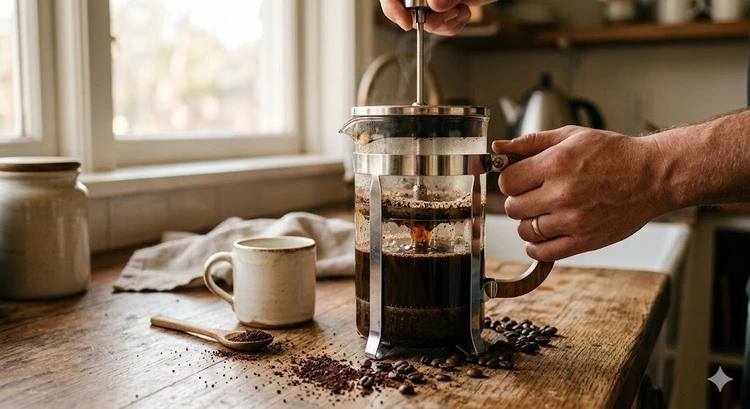
After brewing, slowly press the plunger down.
Don't force it.
If the plunger feels unusually difficult to push, your grind may be too fine.
Step 8: Pour Immediately
Once you've pressed the coffee, pour it into your cup or serving container.
Avoid leaving the coffee sitting on the grounds for an extended period.
Simple French Press Recipe
Here's an easy recipe to save:
☕ French Press for 1–2 cups
Coffee: 20 grams
Water: 300 grams
Grind: Coarse
Water temperature: 195–205°F
Starting brew time: About 4 minutes
Instructions:
-
Heat water.
-
Grind coffee coarsely.
-
Add coffee to the French press.
-
Add hot water.
-
Stir gently.
-
Steep for about 4 minutes.
-
Slowly press the plunger.
-
Pour and enjoy.
That's it.
Why Does My French Press Coffee Taste Bitter?
If your French press tastes too bitter, there are several things you can try.
Try a slightly coarser grind.
Very fine grounds can extract too quickly.
Reduce brewing time.
If you're brewing for longer than necessary, experiment with a shorter brew.
Check your water temperature.
Very hot water can affect extraction.
Adjust your coffee-to-water ratio.
You may simply be using too much coffee.
Make one change at a time so you know what actually improves the cup.
Why Does My French Press Coffee Taste Weak?
If your coffee tastes thin or weak, try:
-
Using slightly more coffee
-
Using slightly less water
-
Grinding slightly finer
-
Adjusting your brewing time
Again, don't change everything at once.
Start with one adjustment.
Why Does My French Press Coffee Taste Sour?
If your coffee tastes unusually sour or sharp, it may be under-extracted.
Try:
-
A slightly finer grind
-
A little more brewing time
-
Adjusting the coffee-to-water ratio
-
Checking your water temperature
Taste after each adjustment.
Why Is There Sediment in My French Press?
Some sediment is normal with French press coffee.
Unlike paper-filtered brewing methods, a French press doesn't completely remove all of the tiny coffee particles and natural oils.
If you want less sediment, you can experiment with:
-
A slightly coarser grind
-
A slower pressing technique
-
A cleaner filter
-
Avoiding overly fine coffee particles
Can You Use Ground Coffee in a French Press?
Yes.
If you're buying pre-ground coffee, choose a coarse grind whenever possible.
If you're using whole beans, grind them coarsely just before brewing.
The advantage of whole beans is that you can control the grind yourself.
Can You Use Any Coffee for French Press?
Almost any coffee can be brewed using a French press.
You can experiment with:
-
Light roast
-
Medium roast
-
Dark roast
-
Single-origin coffee
-
Coffee blends
The most important starting point is using the appropriate grind and then adjusting the recipe to your taste.
What Is the Best Coffee for French Press?
There's no single coffee that everyone will agree is the best.
The right choice depends on your preferred flavor.
If you like:
Bold and rich: Try a darker roast.
Balanced: Try a medium roast or blend.
More origin-focused flavors: Try a single-origin coffee.
The French press gives you plenty of room to experiment.
French Press vs Drip Coffee
| Feature | French Press | Drip Coffee |
|---|---|---|
| Brewing | Immersion | Water passes through grounds |
| Grind | Coarse | Usually medium |
| Equipment | French press | Drip machine |
| Control | High | More automated |
| Sediment | Some possible | Usually very little |
| Convenience | Simple manual process | Very convenient |
If you enjoy actively making your coffee, French press is a great option.
If convenience is your priority, an automatic drip machine may be easier.
French Press vs Pour Over
Both methods can produce excellent coffee, but the experience is different.
French Press
-
Coarse grind
-
Immersion brewing
-
Simple technique
-
More body
-
Some sediment possible
Pour Over
-
Medium to medium-fine grind
-
More controlled water flow
-
Paper filtration is common
-
More hands-on technique
Try both and see which style you prefer.
How to Make French Press Coffee for a Crowd
Making coffee for several people is easy.
Simply scale your recipe.
For example:
30 grams coffee + 450 grams water
or
40 grams coffee + 600 grams water
Maintain approximately the same ratio and adjust according to taste.
If you're making a large batch, make sure your French press is large enough to comfortably hold the coffee and water.
How to Clean a French Press
Cleaning your French press regularly is important.
After brewing:
-
Remove the coffee grounds.
-
Rinse the carafe.
-
Rinse the plunger and filter.
-
Wash with mild dish soap when needed.
-
Allow everything to dry.
Coffee oils and residue can build up over time.
A clean French press helps keep your coffee tasting fresh.
Choosing Coffee for Your French Press
If you want to brew French press coffee with Arvea, look for a coffee that is available in a coarse grind or choose whole beans and grind them yourself.
Arvea currently offers coffee options with coarse grind selections, including its Cold Brew Coffee, along with other coffees available in multiple grind formats.
You can explore the selection and choose the coffee and size that fit your routine.
Frequently Asked Questions
What grind size is best for French press?
Coarse is a good starting point for French press coffee.
How long should French press coffee steep?
Around 4 minutes is a useful starting point, but brewing time can be adjusted according to taste.
How much coffee should I use in a French press?
Start with approximately 1 gram of coffee for every 15–18 grams of water.
What temperature should water be for French press?
Around 195–205°F (90–96°C) is a useful starting range.
Can I use espresso grind in a French press?
It's generally better to use a coarse grind. Espresso grind is much finer and can create excessive sediment and make pressing difficult.
Is French press coffee stronger than drip coffee?
It can taste fuller or more intense depending on the recipe, but "stronger" can refer to flavor concentration, body, or caffeine, so the brewing method alone doesn't determine everything.
Can I use whole bean coffee for French press?
Yes. Grind the whole beans coarsely immediately before brewing when practical.
Final Thoughts
French press coffee doesn't need to be complicated.
Start with:
Coarse coffee grounds
A consistent coffee-to-water ratio
Hot water
About 4 minutes of brewing
A slow press
Then taste your coffee and adjust.
Once you find the combination you enjoy, French press can become one of the simplest and most satisfying ways to make coffee at home.
Good coffee doesn't have to be complicated. Sometimes all you need is great beans, hot water, and a French press.





















Leave a comment